From a very young age, I noticed that very different things happening around me were all being called “Christianity.” Some people lived in ways that didn’t match anything I had ever been taught about the faith, while others Beven opposed each other outright. In my late teens and early twenties, I threw myself headfirst into the faith and tried to figure out what I was missing. I joined the church choir, tried to start a youth Bible study at one point, and regularly found myself overwhelmed by the Holy Spirit to the point of tears. I kept thinking that if I committed enough, I would finally see what everyone else did. But what I found instead was something people rarely take the time to examine.
In 1 Corinthians 1, Paul notes that the earliest Christians were already splitting into groups based on which teacher they followed, and he tells them not to. On an unrelated note, did you know the United States alone has at least 200 major denominations? And if you include the smaller and less‑known groups, that number rises to well over 2,000. Taking into consideration the thousands of non‑denominational churches that each operate with their own doctrines and interpretations, the sheer number of differences becomes impossible to ignore. No country on earth has produced more Christian denominations than the United States, and that level of fragmentation is not something that can be dismissed as normal.
When any other belief system has more than one interpretation, most people usually rush to say that proves the whole concept is unreliable. But American Christianity easily has over ten thousand interpretations, because every group insists its own understanding is the correct one, even when those understandings contradict each other outright. I am constantly told that these are just minor differences, but add enough together and you get a different path of understanding that seems to lead to a totally different God. I do not understand why disagreement discredits every other tradition, but is expected, accepted, and even defended inside Christianity.
I want to be clear that I am not trying to discount Christianity. I think there is real value in most religions, as they usually teach people how to come together, build community, and relate to each other in meaningful ways. But a belief system is only as good as the person applying it, and just claiming to be a Christian does not automatically make someone a good person. It’s ironic that people who insist everyone else’s identity must be proven rather than declared rarely apply that rule to their own faith. Without constant introspection and humility, even the best ideology can be twisted into something harmful. In 1 Corinthians 5, Paul says Christians should focus on accountability within their own community rather than judging outsiders, and passages like 1 Timothy 5 make it clear that this includes holding their leaders accountable when necessary.
Some people might argue that these differences are secondary, and that most denominations agree on the essentials, but that argument collapses the moment you ask who gets to define what counts as essential. Those definitions shift depending on what each group feels is the most important tradition to protect. Christianity presents itself as a faith built on clarity, revelation, and a God who is not the author of confusion, but if that is to remain true, then the level of disagreement we see now is not something that can be brushed aside as harmless variety. Disagreement in science is expected because the data is incomplete; disagreement in Christianity is harder to explain because the truth is claimed to be complete, revealed, and guided by the Spirit. If God is not the author of confusion, then this much confusion demands an explanation.
Take communion, for example. You can see the difference immediately: Roman Catholics teach that the bread becomes the literal body of Christ, while most other churches treat it as symbolic. Obviously only one of them can be right. And when it comes to baptism, why would anyone join a United Church of Christ congregation that baptizes infants with a sprinkling of water when other churches, like the Pentecostal Holiness Church, insist that baptism only counts if it happens after salvation and by full immersion? And even on salvation itself, is the Orthodox Presbyterian Church correct that salvation cannot be lost, or does the Nazarene view mean that churches teaching “once saved, always saved” are giving people confidence in a salvation that, by their own doctrine, could still be lost, which would mean those churches are unintentionally damning the very people they claim to protect?
And the disagreements don’t stop at the major doctrines. Should someone trust the Free Will Baptist churches that say alcohol is a sin, or the Anglican churches that serve wine at communion? Does God prefer a Wesleyan Holiness church that forbids dancing or a Vineyard church that encourages it? And what if speaking in tongues really is a sign of the Spirit, as some denominations like the Assemblies of God insist, even though groups like the Quakers do not expect it at all?
Many people might be wondering why I am even bothering to ask questions like these, but if each denomination claims to be teaching the truth, then it seems that choosing the wrong one could be just as serious as choosing the wrong religion. If salvation depends on correct doctrine, then choosing the wrong denomination could have the same consequences as choosing the wrong religion. This is a possibility that most Christians never acknowledge. It is not as if these disagreements have always been harmless either. Some of these conflicts were serious enough to cause splits, fights, and even violence. People have been excommunicated, driven out, and in some periods of history even killed over issues ranging from baptism practices, to what to do when someone was left‑handed, to whether churches should even have indoor plumbing. When disagreements that small could lead to consequences that big, it is hard to pretend the differences do not matter now. How do you think all the denominations were formed in the first place?
From the outside looking in, trying to differentiate between these versions of Christianity is not much different than choosing between Christianity, Judaism, or Islam. All three come from the teachings of Abraham and claim to be the exclusive truth, but they all disagree with each other on core doctrine. All three claim to be the true continuation of Abraham’s covenant, all three reject the others’ central claims, and the difference between them is one of scale, not structure. If Christians cannot explain why one denomination is the right one among thousands, I do not know how anyone outside the faith is supposed to understand why Christianity itself is the right choice. Yet they often look at the person questioning them as if that person is missing something obvious, even though it only makes sense to those who already accept the framework it is built on. If the people who insist the differences are obvious cannot explain them without using circular logic, then they cannot expect outsiders to understand what they themselves cannot make clear.
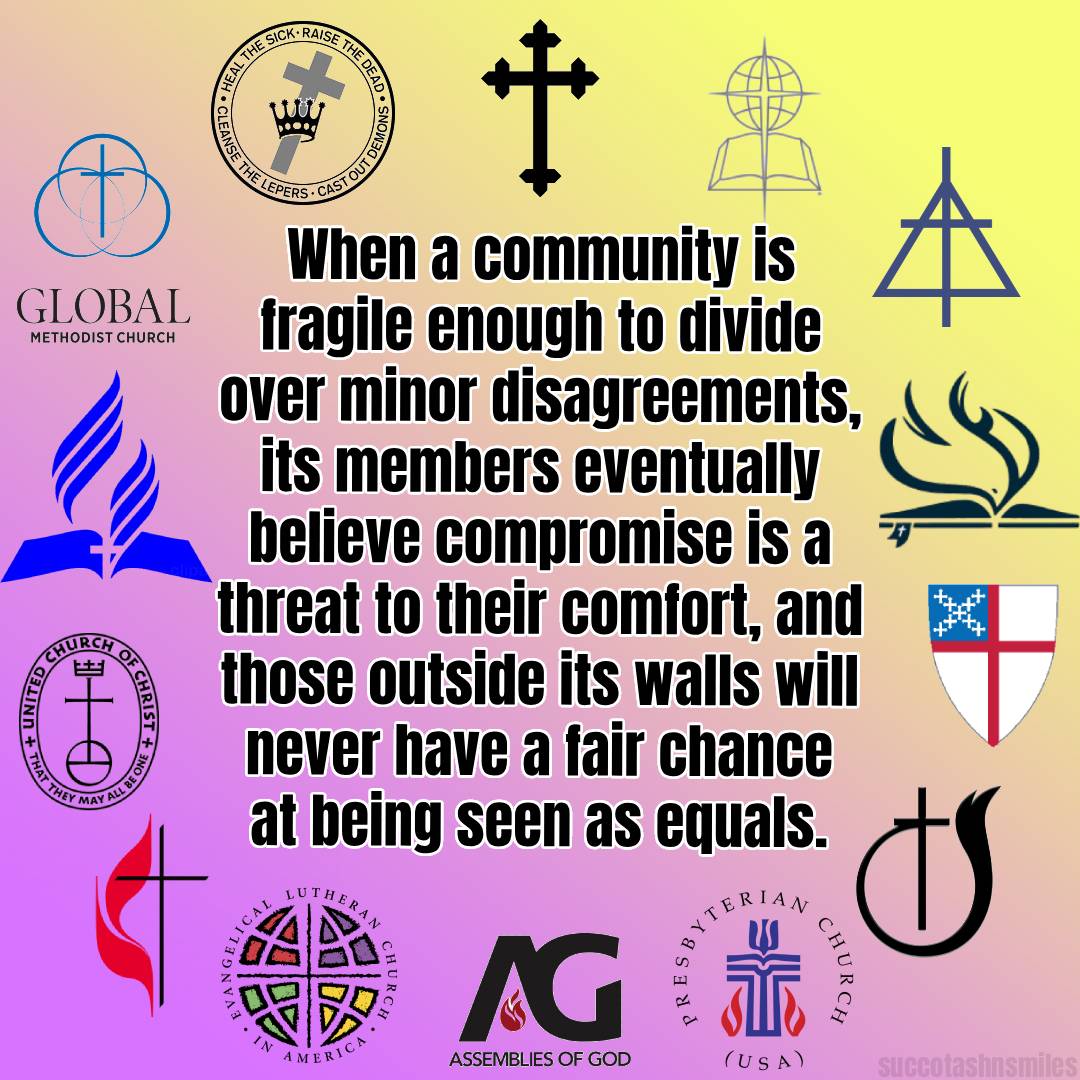
People assume Christianity splintered because believers argued too much, but the opposite is true. It splintered because people refused to compromise. Every denomination exists because someone decided their interpretation was the only acceptable one and chose to walk away rather than stay in a community that disagreed. You don’t have to look further than the fairly recent United Methodist and Global Methodist split to see how this works. That division didn’t happen because people were constantly fighting; it happened because the conflict was avoided for decades. The faith is treated with such delicacy that confronting contradictions feels like betrayal, so silence becomes the default and fracture becomes the escape route. What looks like unity is really just the absence of permission to speak, and what looks like strength is a fragility held together by people choosing the highway to protect their own version of the truth.
And that is why these differences can’t just be brushed off as harmless variations. A belief system that breaks apart every time people finally speak honestly about their disagreements isn’t showing strength; it’s showing limits. When unity depends on avoiding hard questions, the result isn’t clarity but a kind of quiet drift where the label stays the same while the meaning underneath it keeps changing. I’m not pointing this out to attack Christianity. I’m simply pointing out that if the faith is as strong as people claim, it should be able to handle being looked at directly. If it’s so delicate that it dissolves under the slightest scrutiny, then avoiding the questions to preserve it simply postpones what was always going to happen.
Leave a Reply