What debate spectacles reveal about power, performance, and unfair advantage.
Some people say they can drive, but what they really mean is they can get from point A to point B. Barely. Without hitting anything. Hopefully. That is the baseline. Survival mode, not mastery.
Then there are people who want to learn more. They practice parallel parking, smooth lane changes, maybe even drifting in a controlled space. They are not just getting by. They are building skill.
And then there are professionals. Drivers who can handle a car at the edge of its limits. Who know how to read a track, anticipate conditions, and execute maneuvers most of us would never attempt.
All of these are driving, but they are not the same thing. Debate works the same way. There is a spectrum between barely stringing together an argument, practicing the craft, and performing at a professional level. Pretending that beating a beginner proves mastery is like a pro racer bragging about leaving a student driver in the dust.
Maybe racing is not your thing. Think about basketball, where there is a difference between someone who can dribble without tripping, someone who has practiced their free throws, and someone who can run plays under pressure in the NBA. Or think about baking, where microwaving a brownie in a mug does not make you Martha Stewart. Whether it is basketball or baking, the point is the same. Skill is not just about the end product. It is about the process and the ability to teach it clearly.
This is where Charlie Kirk comes in. To be fair, he was skilled. He started young, and by the time most of his campus debates went viral, he had been doing this for thirteen years. Thirteen years of repetition in any craft, whether cooking, driving, sports, debating, or writing, will make you sharp. It will give you instincts that beginners simply do not have. That is why, when people point to his debates and say, “Look how good he was,” they are not wrong. He was good because he had put in the time.
But the way he used that skill is where the problem lies. His version of “prove me wrong” debate was like a professional driver challenging teenagers with learner’s permits to a race. The outcome was already tilted; the skill gap was obvious. And instead of using his experience to teach, he used it to perform. It became a way to display his mastery, to feed his own authority, possibly even without realizing it. Rather than showing people how to shift gears or build confidence, he mocked their mistakes and sped past them. That’s not mentorship. That’s not education. It’s performance dressed up as competition.
Even with his last breath, he was still doing it. When asked about mass shootings, his final words were, “Counting or not counting gang violence?” It was not an answer; it was a reframing trick designed to throw the questioner off balance. That moment will be part of his legacy: not as a teacher who built others up, but as a performer who used disruption to keep control.
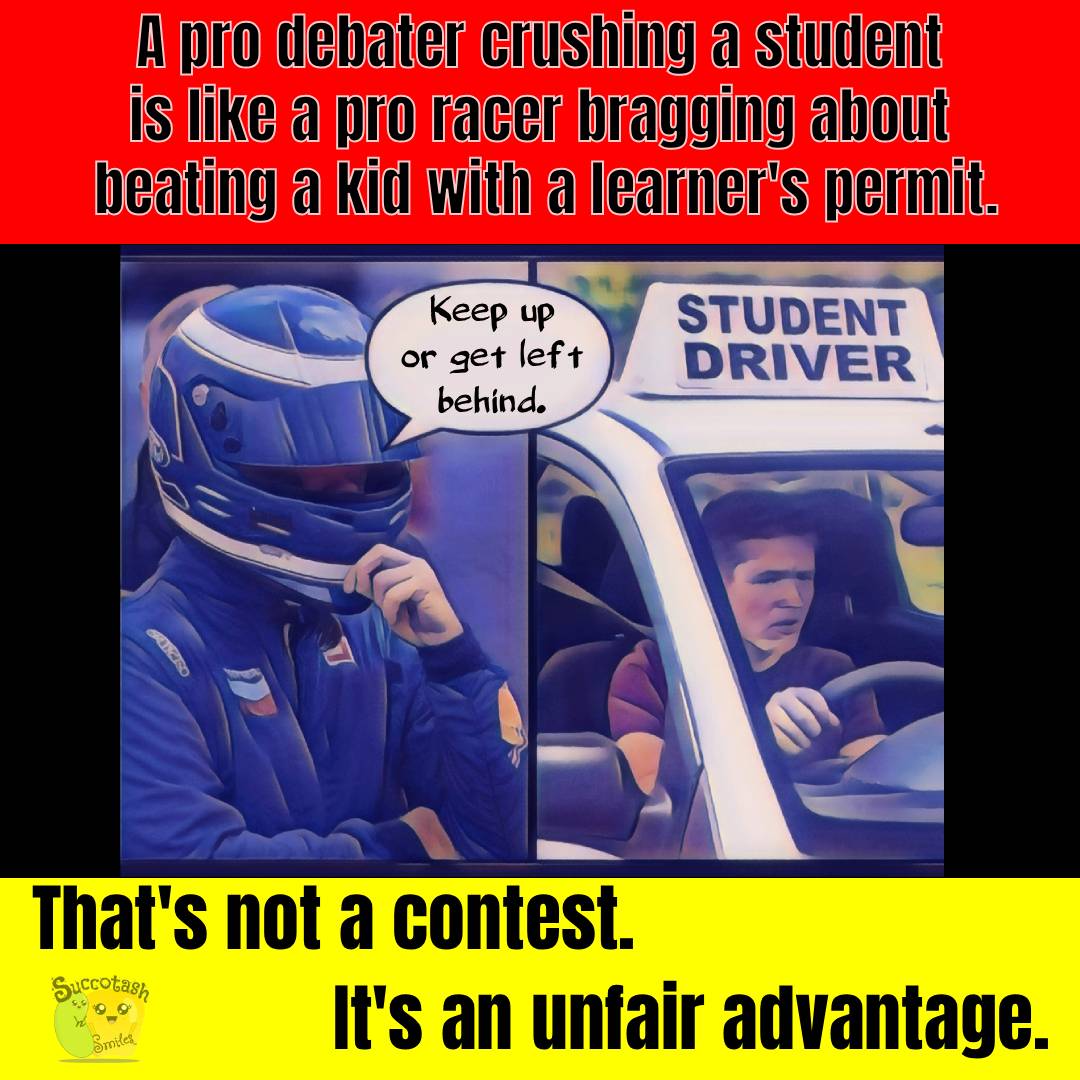
That is why the spectacle of a seasoned political activist debating college students rings hollow. It is not a fair contest. It is a mismatch dressed up as a victory. A pro debater crushing a student is like a pro racer bragging about beating a kid with a learner’s permit. We would not call that a contest. We would call it an unfair advantage.
And yet, in the debate world, people cheer. They clap for the pro as if humiliating a beginner proves brilliance. But we do not celebrate a driver for flooring it past a student driver on their first day. We do not cheer when an NBA player dunks on a middle‑schooler. We recognize it for what it is. Performance, not teaching.
Real teaching is different. It is the instructor in the passenger seat, calmly explaining how to ease off the clutch, how to check your mirrors, how to recover when you stall out. It is the coach who runs drills, not just scrimmages. It is the baker who shows you how to fold the dough instead of laughing when your cake collapses.
The measure of a skill is not how easily you can humiliate a beginner. It is how you carry yourself with anyone, even someone you disagree with, and whether they leave the exchange with a sense of respect for you. That is the difference between teaching and performance, between building others up and simply showing off. And it is something we would all do well to pay more attention to.

A digitally illustrated meme compares debate to racing. On the left, a professional race car driver in full gear and helmet says, “Keep up or get left behind.” On the right, a nervous young person labeled “STUDENT DRIVER” grips the wheel of a car. At the top, text reads: “A pro debater crushing a student is like a pro racer bragging about beating a kid with a learner’s permit.” At the bottom, text reads: “That’s not a contest. It’s an unfair advantage.”
Leave a Reply