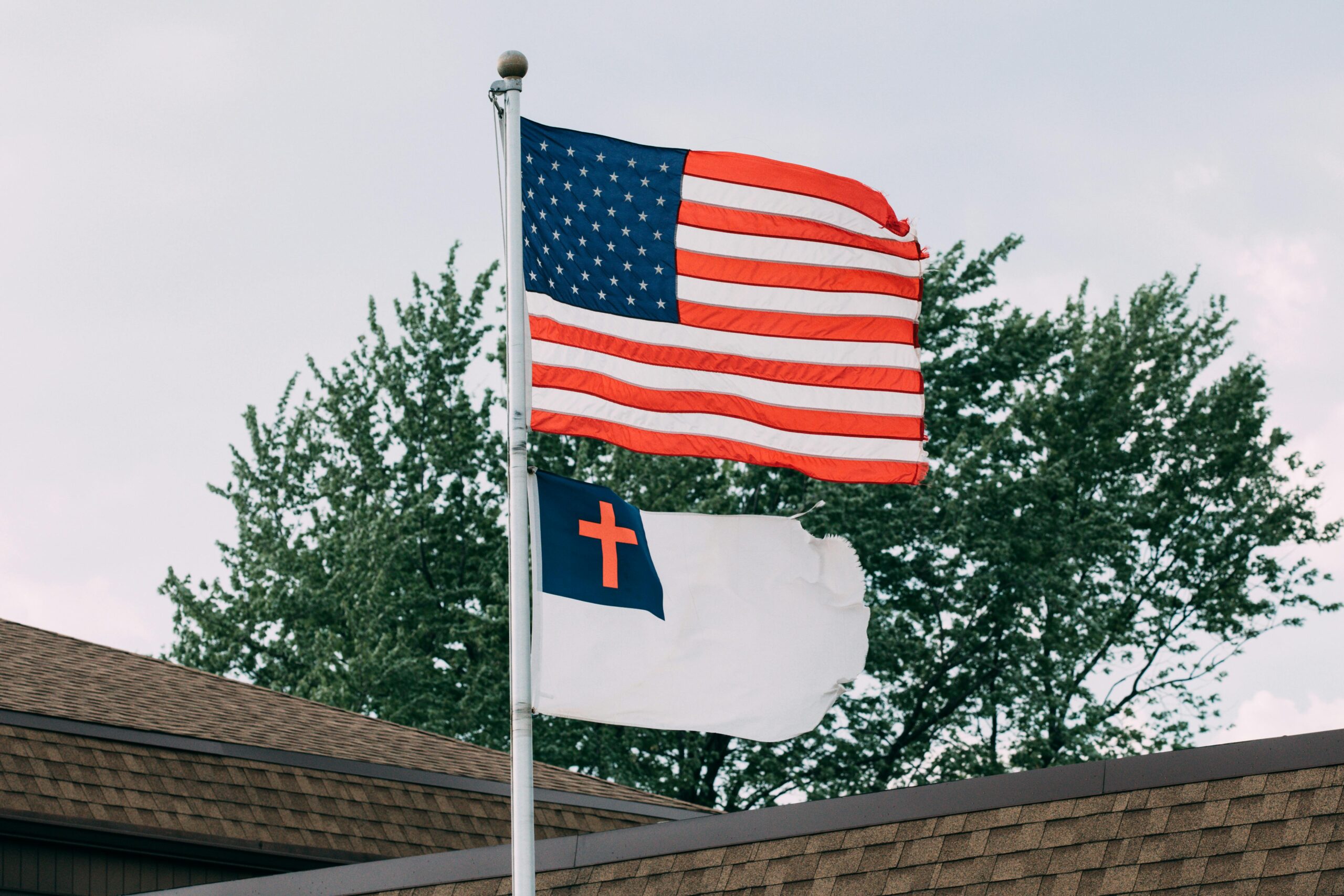
Four centuries ago, the Puritans stepped onto these shores carrying a vision; a “city on a hill,” a light to the nations. It was a potent image, and a dangerous one. Over time, it hardened into something else; the belief that America was not just a nation, but God’s chosen nation. By the Cold War, that myth had been resurrected, polished, and draped in flags and scripture, used to rally against communism and any perceived moral drift. It was a story that could inspire, but it was also a story that could be bent, and in the late twentieth century, it has been bent into a tool for power, its edges sharpened to cut down opponents in the name of God and country.
In the late 1970s and early ’80s, a new coalition of conservative religious leaders learned how to fuse the pulpit with the political machine. The Moral Majority, the Christian Coalition, and their allies turned sermons into campaign speeches; wealthy donors and corporate PACs poured money into their causes; televangelists turned fear into fundraising; talk radio and cable news built closed loops of information where the same talking points echoed endlessly. Thomas Jefferson once wrote, “The God who gave us life, gave us liberty at the same time,” yet liberty here was redefined as the freedom of one religious bloc to dominate the public square.
Over the next four decades, the narrative tightened like a ratchet. America was founded as a Christian nation; our policies are God’s will; to oppose us is to oppose God. Each claim rested on the last until the scaffolding of myth and selective history became indistinguishable from truth inside the movement. It was not just theology; it was branding, and it was effective.
We do not arrive in this world as blank slates; none of us chose the air we first breathed. We inherited stories, symbols, and assumptions long before we had the tools to question them. No one handed us the full picture, and no one told us every truth. That is not a mark of ignorance or weakness; it is simply the human condition. The measure of us is not whether we were born inside the cage, but whether we are willing to see the bars when the light hits them.
Millions of Americans did not choose this ideology; they inherited it. It was the air they breathed, the language of their schools, churches, and neighborhoods. They were told the bars were there for their protection. Maya Angelou’s words come to mind; “Do the best you can until you know better. Then when you know better, do better.” The challenge is not to condemn those born in the cage, but to show them the door; to let them see the sky.
And here is where we have to be honest; faith is good, pride in your country is good, but they cannot be all that we have. We were given minds to think, hearts to discern, and the capacity to hold complexity without fear. Patriotism without reflection becomes nationalism, and faith without humility becomes idolatry.
Pride, too, carries a double edge. It can be the quiet strength of belonging, the warmth of shared purpose, or the dignity of knowing where you come from. But when pride is left unchecked, it calcifies into arrogance: the kind that mistakes dominance for righteousness and certainty for truth. It stops being a celebration and becomes a shield, deflecting critique, silencing doubt, and turning faith into a performance of superiority. That kind of pride doesn’t protect us; it isolates us.
We also have to be careful whose voice we are amplifying when we say we speak for God. History is full of leaders, preachers, and politicians who have wrapped their own ambitions in the language of the divine; who have claimed God’s authority to bless their wars, excuse their greed, or silence their critics. The danger is not only in the lie itself, but in the way it hardens hearts against the possibility that God’s will might look different from our own.
Our forefathers understood this; many had seen firsthand how state‑sanctioned religion breeds corruption in both church and government, and they fought to build a wall between them to protect the integrity of each. If we are not vigilant, we stop listening for the still, small voice and risk mistaking the echo of our own desires for the voice of heaven.
Now, the tower they built is trembling. Demographics are shifting; younger generations, including many raised in evangelical homes, are asking why the faith of compassion and humility has been welded to the machinery of empire. Scandals have exposed hypocrisy; the internet has punctured the information bubble. Abraham Lincoln warned, “America will never be destroyed from the outside. If we falter and lose our freedoms, it will be because we destroyed ourselves.” The corrosion is internal, and it is visible.
This is not a call to abandon faith, or to stop loving your country; it is a call to deepen both, to let them be strengthened, not weakened, by truth, by empathy, by the courage to admit when we have been wrong. The founders gave us a secular Constitution not to erase religion, but to protect it from the corrupting influence of state power. That is the American promise worth defending.
The tower built on fear and falsehood is cracking; the cage door is ajar. What comes next depends on whether we have the courage to step into the open air together; to build something truer, freer, and more just than the myth we were given; to prove that we are more than the stories we inherited, and that we can choose the truth over the comfort of the familiar.
It is time to think as deeply as we believe; to love our country enough to tell it the truth; to hold our faith and our freedom with humility, not as weapons but as gifts. We need to use our minds as fiercely as our hearts, to discern as boldly as we hope, and to remember that the America worth saving is the one we build together: in honesty, in courage, and in full daylight.
Leave a Reply