America has always lived in the tension between its founding and its promise. At the beginning, the rules were written by and for a narrow group: white, property-owning men formed in a British Protestant culture. Many of them used Christian language in public life, and some were devout, while others leaned toward Enlightenment rationalism or deism. Whatever their private beliefs, the civic structures they built reflected their world and treated men like them as the default citizen.
Even so, the words they wrote reached further than they themselves did. When they declared that “all men are created equal,” they planted a seed bigger than their own imaginations. They said it was for everybody, even though in practice they only meant a few. By the standards of the time, renters, servants, and the propertyless could not vote. Only about six percent of the population had a voice in government. If we really want to go back to the “old days,” then we should be honest: that would mean only homeowners could vote today. About 34 percent of American households rent, which is around 45 million households, representing more than 100 million people. All of them would be shut out of democracy. That’s not freedom; it’s regression.
Over the years, America has been the story of expanding what “everybody” means. The Reconstruction Amendments abolished slavery and defined citizenship. The Nineteenth Amendment extended the vote to women. The Civil Rights Movement forced the nation to confront segregation and voter suppression. Immigration reform opened doors beyond Europe. Step by step, the circle of belonging widened.
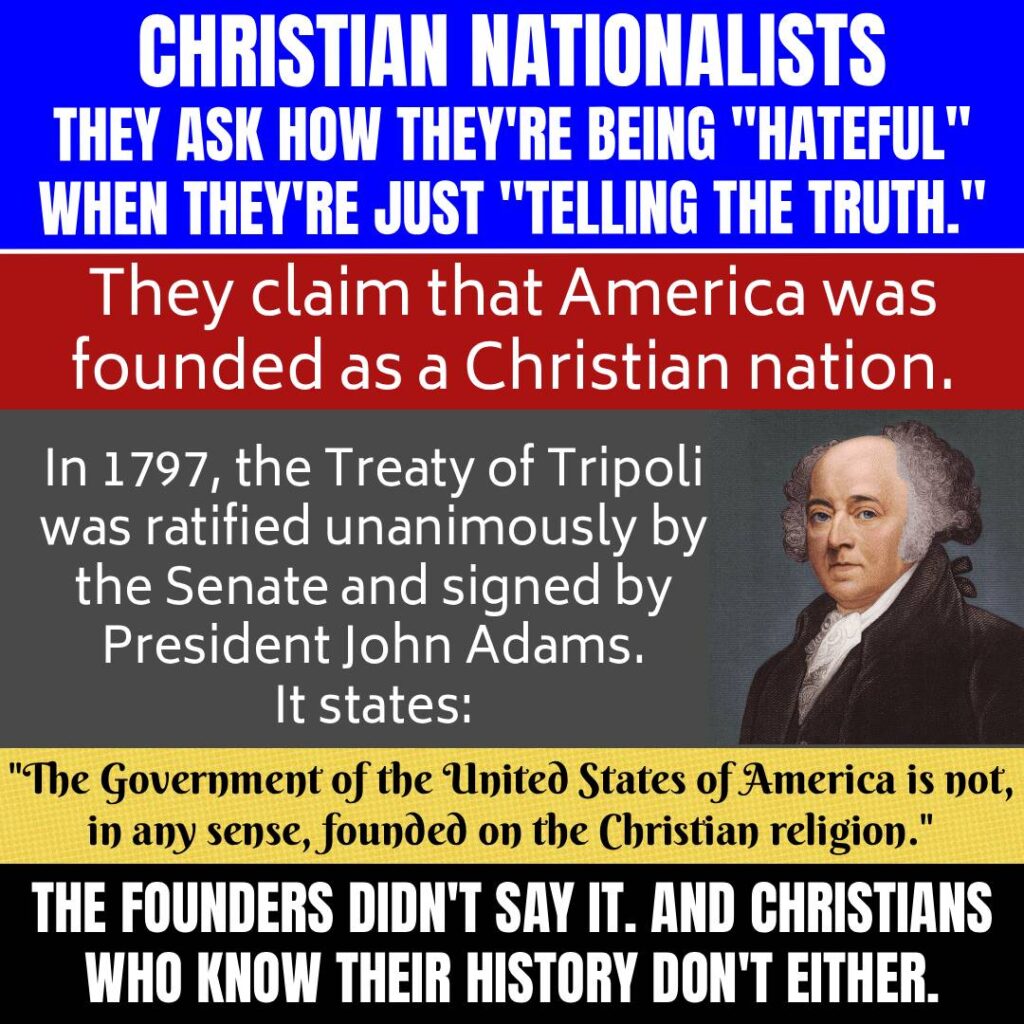
From the beginning, there were also clear signals that Christianity was not meant to be the legal foundation of the United States. The Treaty of Tripoli, ratified unanimously by the Senate in 1797 and signed by President John Adams, stated plainly that “the Government of the United States of America is not, in any sense, founded on the Christian religion.” George Washington, in his 1790 letter to the Jewish congregation in Newport, assured them that the government “gives to bigotry no sanction, to persecution no assistance.” These words show that even the earliest leaders understood the promise of America as larger than any one faith.
That expansion is what makes America what it is. But today, there are voices trying to pull us back. They act as if the country has gotten too free, as if liberty has stretched too far beyond the boundaries they are comfortable with. They speak as though Christianity is the default identity of the nation, as though whiteness is the unspoken baseline, as though wealth and power are the natural qualifications for leadership. Through that lens, their claims appear orderly and righteous. Step outside it, and the logic falls apart. If you flip the target of their rhetoric, the bias becomes obvious. It only sounds neutral if you assume their identity is the standard against which all others are measured.
America did not promise permanent dominance for any one group, but liberty and justice for all. The real work of patriotism is to keep adjusting our laws, institutions, and habits until that is true in practice. We do not tear down the country by changing the rules to fit everybody. We honor it. If the founding set the frame, the promise set the direction. Our task is to keep moving that direction forward.
The people who try to hold us back want to freeze America in its earliest form, to pretend that the promise was never meant to stretch beyond them. But the truth is that the future has always been larger than the founding. The real test of loyalty to this country is not clinging to the old defaults but insisting that the words liberty, equality, and justice become real for everybody. That is the America worth fighting for, and that is the America we can forge together.
Leave a Reply