When I was growing up, I saw people living out Christianity in very different ways. Some got loud and angry when they talked about God. Some were calm and gentle. Others never spoke about faith at all but still called themselves Christian. I often felt like a bad Christian because I didn’t understand those differences. I never felt the kind of anger some people carried, except when I saw people inside the church twisting Scripture or speaking in ways that didn’t match the Jesus I read about. But when I tried to ask others about them, I was told not to judge. For years I thought the problem was me. Only later, watching many of them embrace Christian nationalism, did I understand why their version of faith had always felt so different from mine.
Christian nationalism rests on a twisted baseline, an unexamined self-assurance that treats its own fusion of faith and political power as gospel truth and then brands anyone who dares point out its flaws as a “bigot,” a “libtard,” or even “demonic.” By weaponizing words to silence dissent, its followers ensure that genuine self-reflection and correction never occur, betraying the very humility that Jesus insisted must precede any moral judgment.
The New Testament repeatedly insists that believers look inward before judging outward. In Matthew 7:3–5, Jesus warns us to remove the plank from our own eye before criticizing another’s speck. In James 1:19–20, we’re urged to be quick to hear and slow to speak, because human anger and defensiveness produce nothing of lasting righteousness. Paul echoes this in 1 Corinthians 11:28 when he tells believers to examine themselves before sharing in the Lord’s Supper. These teachings undercut the nationalist posture that equates political dissent with spiritual betrayal.
Pointing out hypocrisy or misapplied doctrine elicits an immediate shutdown. You’re “confused,” you “just don’t know what you’re talking about,” or, worst of all, you’re a tool of demonic forces. No argument is heard, no Scripture is wrestled with. This bigotry shield turns honest discourse into a hostile echo chamber where learning and repentance cannot occur.
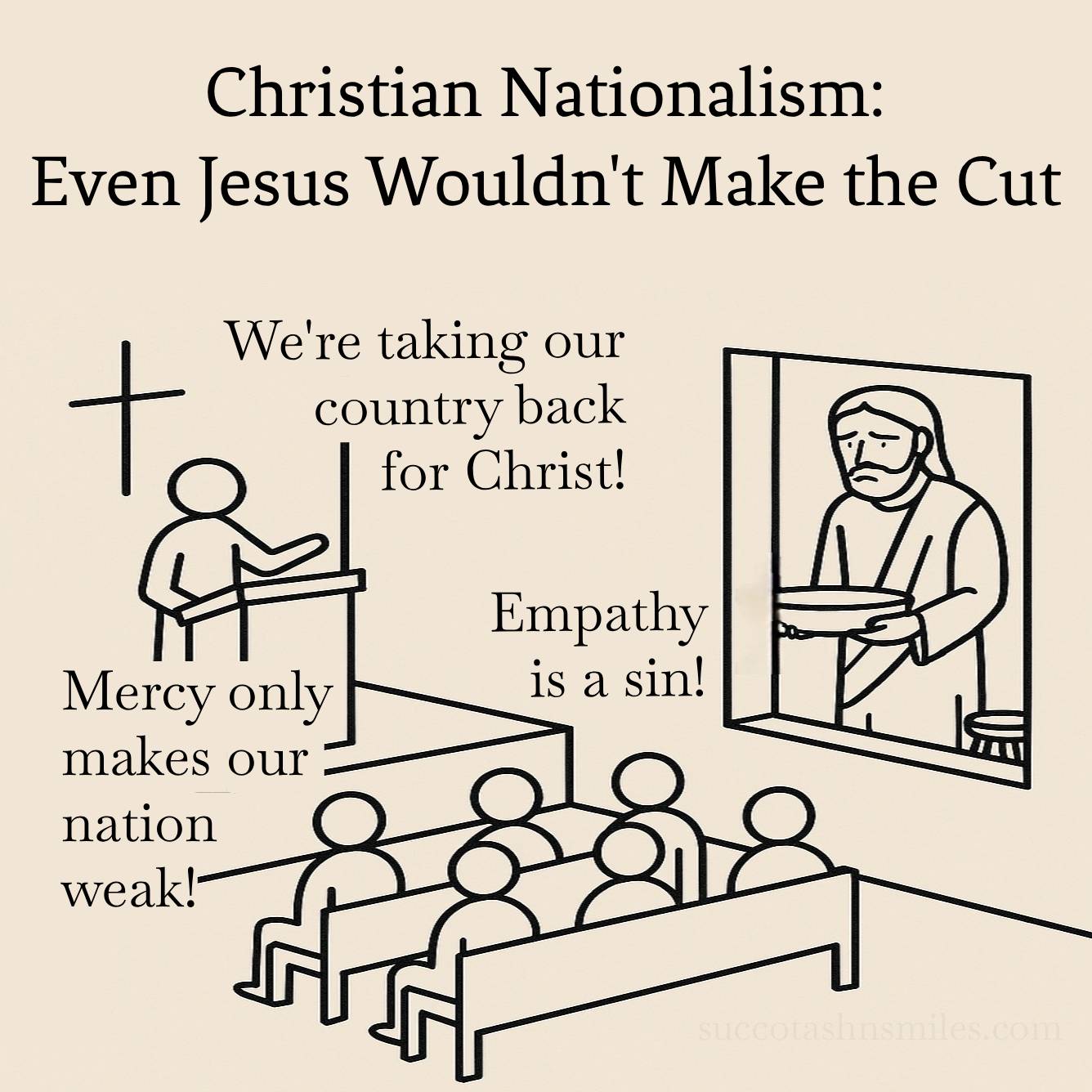
By the same litmus tests that applaud scorched-earth partisanship against immigrants, decry critical-race theory as Marxist indoctrination, banish calls to defund the police, and castigate any show of compassion toward the marginalized as weakness, they label anyone who shows enemies respect a traitor and weaponize Scripture to silence dissent. Under this purity code the Prince of Peace himself would be called performative or woke, accused of being paid to curry favor.
The one who washed his disciples’ feet, multiplied loaves and fishes to feed five thousand, healed the sick, comforted the grieving, ate with tax collectors and sinners, and prayed for his crucifiers would be branded not a real Christian. His call to bless those who curse us, to give to all who ask, and to pray for those who persecute us would be recast as betrayal of tribal loyalty. In their warped mentality, genuine mercy is the ultimate offense and the true Christ stands condemned at the gates of their own movement.
Worse still, Christian nationalists do not merely silence external critics; they steamroll over rich theological diversity within Christianity itself. Whether you come from a liberal mainline congregation that rejects political manipulation or from a theologically conservative fellowship that objects to the idols of power, you find yourself excluded from the true-Christian club once you question their fusion of church and state. Liberal Christians decry the political uses of Scripture, and many conservative pastors oppose the nationalist agenda. Yet both groups are dismissed as not real Christians, proof that this movement exempts itself from the very accountability it demands of everyone else.
Some may wonder why Christian nationalists pursue such absolute control. To them, the rationale is simple: we’ve endured decades of misplaced leadership under flawed secular elites. If governance will always be shaped by human weakness, they argue, it makes more sense to let our own flawed champions, those who promise to rule by their narrow reading of Scripture, occupy the reins. This black and white logic, however, only perpetuates a cycle of wrong people in power, blind to how unchecked certainty fosters the very corruption they claim to oppose.
Some readers may call this critique too political or impious, insisting Christianity should rise above partisan fights. But Christian nationalists politicized the faith long ago by marrying the kingdom of God to earthly agendas, and they’ve been rewarded with power ever since. Now Christians committed to the gospel must reclaim their faith and its true promise if they want to see the gospel’s rewards restored. Restoring a healthy separation of church and state isn’t a retreat from public life; it’s the only way to recover the gospel’s transformative power apart from partisan power plays. As Christians, we must disentangle our faith from political idolatry so our witness to Christ remains untainted by earthly allegiances.
Psychologically, the nationalist phenomenon makes sense. Identity-protective cognition compels believers to defend any conviction that binds them as a social tribe. Moral licensing allows public displays of piety to excuse private abuses of power. Insulated echo chambers drown out nuance, amplifying collective certainty while erasing dissent. The harder these groups preach unity, the more rigid they become, until any crack in the façade seems like betrayal.
Scripture and church history provide a different path. The prophets thundered against unjust laws that rob the poor (Isaiah 10:1–2) and trample the weak (Micah 3:9–10). Paul’s letters brim with mutual rebuke meant to sharpen faith, not silence it. Early Christians paid taxes when governing authorities upheld the common good and resisted when laws violated conscience. They did not hide behind platitudes; they demanded their leaders live up to divine standards of mercy, justice, and humility.
Christian nationalism thrives on unexamined certainty defended by slurs and selective scripture-sniping. True faith, by contrast, welcomes correction. It lets justice roll on like a river (Amos 5:24), honors dissenting voices, and confesses wrong before condemning another. If our taxes, our votes, and our public witness are to reflect the heart of the gospel, we must first examine our own planks, listen when we would rather speak, and refuse to let any modern avatar of power off the hook for injustice. Our faith must be more than a banner raised over political ambition. It must be a force that would welcome Jesus with open arms.
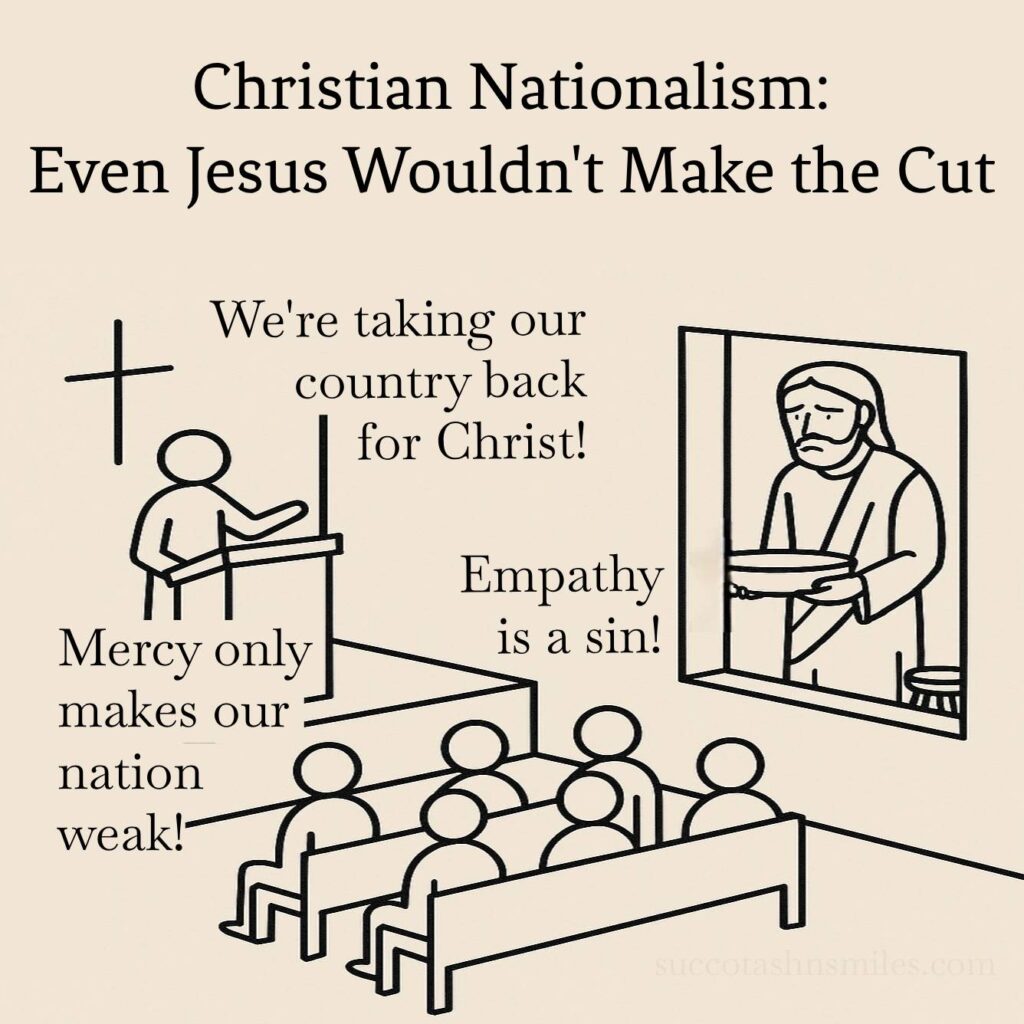
Minimalist black‑and‑white line drawing of a church interior in side view. On the left, a stick‑figure preacher stands at a pulpit beneath a cross, addressing a small stick‑figure congregation seated on the right. A small window in the wall shows Jesus outside, wearing a robe, holding a wash basin, with a small stool at his feet. He looks sad as he peers in. Speech bubbles from the preacher read, “We’re taking our country back for Christ!” “Empathy is a sin!” and “Mercy only makes our nation weak!”
Leave a Reply